
The foundation everything else stands on.
Search Engine Optimization Management for
Home Service Contractor
SEO is not a checklist you complete and walk away from. It is the ongoing professional discipline of being found by the right customer at the right moment. It is the base layer beneath every AI citation, every local recommendation, every direct call from someone who needed you an hour ago.
THE SHORT ANSWER
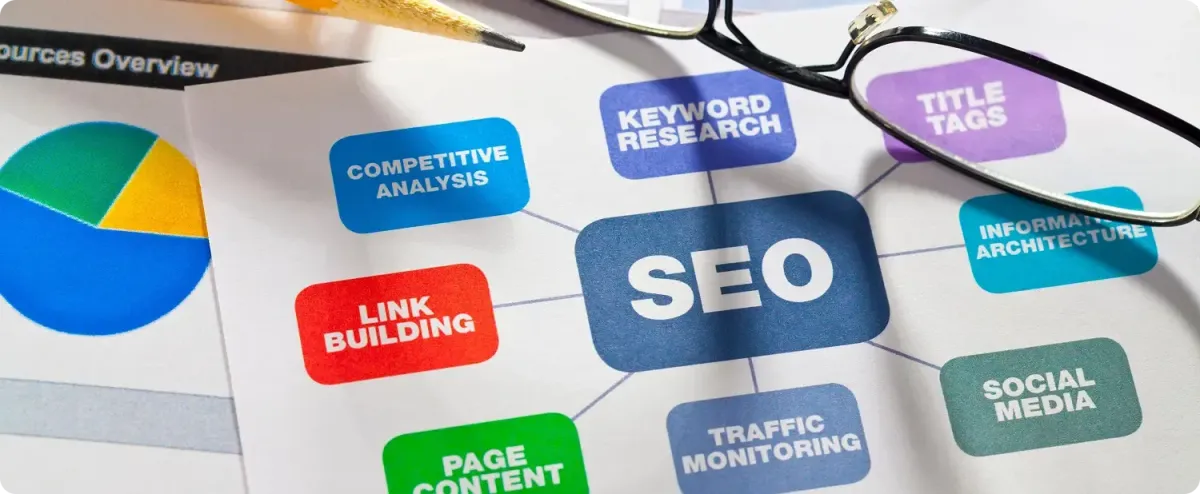
SEO Management is the ongoing discipline of being found by the right customers at the right moment through search. It combines consumer intent, on-page structure, technical site health, local search optimization, internal and external linking, social signals, and continuous adaptation to algorithm changes. It is the foundation layer beneath AEO — the work that must be right before AI engines can cite you. Built by Kip Hudakoz, in the SEO game since 2003.
SEO is the foundation. AEO is what gets built on top
AI engines pull from the same web Google has been ranking for two decades. If your site is not crawlable, not structured, not authoritative, and not trusted at the foundation level, the AI engines have nothing to cite. There is no AEO without SEO underneath it.
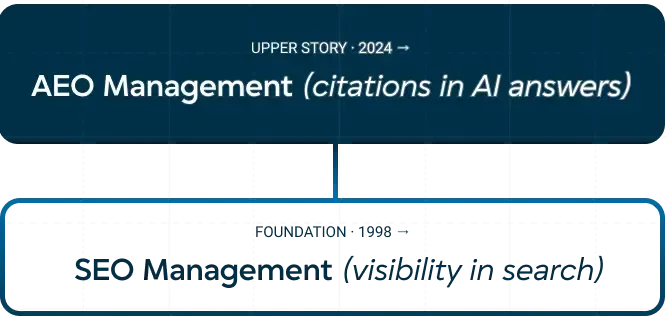
Strong SEO is the precondition for AEO. Build the foundation. Then build on top of it.
SEO is not one thing.
SEO is more than picking a keyword that ranks. It is understanding the intent of the consumer and matching the content to that intent.
You can have a high-volume keyword and miss the mark completely.
Here is what SEO actually is — every dimension working together as one ongoing discipline. Miss any of these and the rest will not save you.
01
Consumer Intent
Understanding what the customer is actually trying to accomplish when they search. The keyword is the surface; the intent is the substance.
02
Site Structure & UI
How the site is organized, how it loads, how it feels. Google reads structure. Customers feel it. Both matter.
03
H1 Tags & On-Page
The hierarchy of headings, the meta data, the alt text. The skeleton of the page that tells search engines what it is.
04
Internal & External Links
How your pages connect to each other. How the rest of the web connects to you. The link graph still tells the truth about authority.
05
Relevant Information
Content that answers what was searched for. Not stuffed. Not padded. Relevant to what the customer actually needed to know.
06
Social Signals
The conversation happening about your business on other platforms. Reviews, mentions, shares — they all feed the authority signal.
07
Site Health
Core Web Vitals, mobile rendering, HTTPS, crawlability, broken link audits. The engineering hygiene Google rewards and customers feel.
08
Continuous Adaptation
Algorithms change. Competitors move. Markets shift. The work is never finished — and the moment you treat it as finished, you start falling behind.
Start owning your growth
You've seen what's broken. You know what needs to change.
Now it's your turn to take control.
LOCAL SEO REALITY
For home service contracts, local is the game.
Your customer is not searching across the country. They are searching in your service area for someone who can show up. Google's official ranking system for local search runs on three signals. Get these right and you win the Map Pack. Get them wrong and you are invisible to the customer on the next block.
01 · RELEVANCE
How well your business profile matches the search
The right primary category. The right service descriptions. The right structured data. When a homeowner searches a specific need, the businesses Google considers relevant are the ones whose profiles unambiguously describe that need.
02 · DISTANCE
Proximity to the searcher
The closer you are, the more Google considers you a fit. This is why service area definition, address consistency, and citation accuracy across every directory matter. Mixed signals here read as "we are not sure where this business actually is."
03 · PROMINENCE
How well-known and reviewed you are online
Reviews, mentions, links, social presence, citations across the web. Prominence is the cumulative answer to the question: does the internet treat this business as a real, trusted entity? This is the slowest signal to build and the hardest to fake.
23 Years In The Game
Algorithms come. Algorithms go. The fundamentals stay.
Every major shift in SEO history — and we have lived through every one of them. The agencies that started after 2015 know one era. We have practiced through all of them, watching what holds up and what gets washed out.
2003
How well-known and reviewed you are online
Reviews, mentions, links, social presence, citations across the web. Prominence is the cumulative answer to the question: does the internet treat this business as a real, trusted entity? This is the slowest signal to build and the hardest to fake.
2005
Local search becomes real
Google Local Business Center launches. Local SEO emerges as a distinct discipline. For home service contractors, this is the moment local visibility starts to matter more than national.
2011
Panda — quality enters the algorithm
Thin content gets demoted. Quality becomes a ranking factor. The cheap content farms of the prior decade collapse. Real, useful information starts winning.
2013
Hummingbird — meaning over matching
Google rebuilds its core algorithm to read for intent, not just match keywords. Semantic search arrives. The agencies still chasing keyword density start losing.
2015
Mobile-first reality
Mobile-friendly becomes a ranking factor. Mobile search overtakes desktop. Any site not built mobile-first starts losing visibility. Contractors who ignored this lost local rankings overnight.
2019
BERT — language understanding
Google's algorithm starts reading complete sentences for meaning. Long-tail queries get answered better. The era of natural-language search begins. The keyword game evolves again.
2024
AI Overviews — the upper story arrives
Google AI Overviews launch. The foundation of SEO now supports a second layer above it: AEO. SEO does not go away. It becomes more important — because the foundation has to hold up the new floor.
2026
Where we are now
SEO and AEO operate together. Foundation and upper story. The contractors who win at both are the ones with professionals doing the work — not part-timers, not offshore vendors, not generic playbooks.
Start owning your growth
You've seen what's broken. You know what needs to change.
Now it's your turn to take control.
FROM THE AUTHOR
SEO is a contact sport. Played by professionals.
I started doing SEO in 2003 — promoting local small business growth so I could scale my own home services business. I was not learning it as a consultant. I was using it. Every algorithm update was a thing that either helped me make payroll or did not.
Twenty-three years later, I have watched contractors win and lose at this work over and over. And the pattern is always the same. The ones who lose are the ones who treated SEO as a one-time setup, a side task, or something you hand to the cheapest vendor who will take it. The ones who win treat it as what it actually is.
SEO is more than picking a keyword that ranks. It is understanding the intent of the consumer and matching the content to that intent. You can have a high-volume keyword and miss the mark. SEO is more than keywords. It is structure. It is the UI of the website. It is H1 tags. It is internal and external links. It is information on the page that is relevant to the search term. It is social media. It is site health.
It is not one thing. It is a work in progress.
Algorithms are forever-changing. This is not something you manage in your off-time. It is not something you outsource to an offshore company. It is a contact sport — played by professionals, by students of the game. No different than a five-time MVP Super Bowl Champion.
'"It is a contact sport. Played by professionals. Students of the game. No different than a five-time MVP Super Bowl Champion."
That is the standard. That is the only standard worth having. If you want SEO that actually moves your business, you do not want a part-timer running a playbook. You want a professional. Someone in the game long enough to have seen every shift, and disciplined enough to keep studying it as it changes.
— Kip K. Hudakoz, COO, Oculus Intel · In the game since 2003
FREQUENTLY ASKED QUESTIONS
Real answers for contractors who are tired of
being burned by agencies
1. What is SEO Management?
SEO Management is the ongoing discipline of being found by the right customers at the right moment through search. It is not a one-time setup. It combines understanding consumer intent, on-page structure, technical site health, local search optimization, internal and external linking, social signals, and continuous adaptation to algorithm changes. For a home service contractor, SEO Management is the foundation layer of digital visibility — the work that must be right before AEO can work on top of it.
2. How is SEO Management different from regular SEO?
Regular SEO is often sold as a project — pick keywords, optimize a page, build some links, declare it done. SEO Management is the recognition that SEO is not a project. It is a continuous discipline. Algorithms change. Competitors move. Consumer behavior shifts. SEO Management is the ongoing professional practice of staying ahead of those changes, not the one-time act of catching up to them.
3. Why is local SEO so important for contractors?
Home service customers search with local intent. They are looking for someone in their area who can show up. Google rewards local SEO through three signals — Relevance, Distance, and Prominence. A contractor whose local SEO is weak is invisible to the customer one block away who needed them an hour ago.
4. Why is SEO the foundation beneath AEO?
AI engines pull from the same web Google indexes. If your site is not crawlable, not structured, not authoritative, and not trusted at the SEO level, the AI engines have nothing to cite. Strong SEO is the precondition for AEO. You cannot earn citations in AI answers if you cannot be found at the foundation.
5. Why does outsourcing SEO to cheap or offshore providers usually fail?
SEO is a professional discipline that requires daily attention, judgment, and adaptation to algorithm changes. It also requires understanding the specific business, the specific market, and the specific customer. Generic playbooks executed by people who do not understand the business produce technically present but commercially useless work. SEO is a contact sport. Played by professionals. Students of the game. Anyone outsourcing it as low-cost labor is paying for theater.
6. Who created the Oculus Intel SEO Management methodology?
SEO Management was developed by Kip Hudakoz, who has been working in SEO since 2003 — promoting local small business growth, scaling his own home services business, and watching every major algorithm shift the field has been through. The methodology is the result of 23 years of practice from inside the contractor's chair, not from an outside consultant's view.
Who do you want? Champions know no other way.
A part-timer running a checklist. An offshore vendor cycling through accounts. Or a professional who has been in the game since 2003 and still studies it every day.

Marketing automation and CRM solutions for home service contractors and manufacturers. Full ownership of your websites, sales funnels, SEO, and lead generation systems. Forever.
COMPANY
SERVICES
LEGAL
SOCIAL MEDIA
GUIDES
Copyright 2026. Oculus Intel. All Rights Reserved.